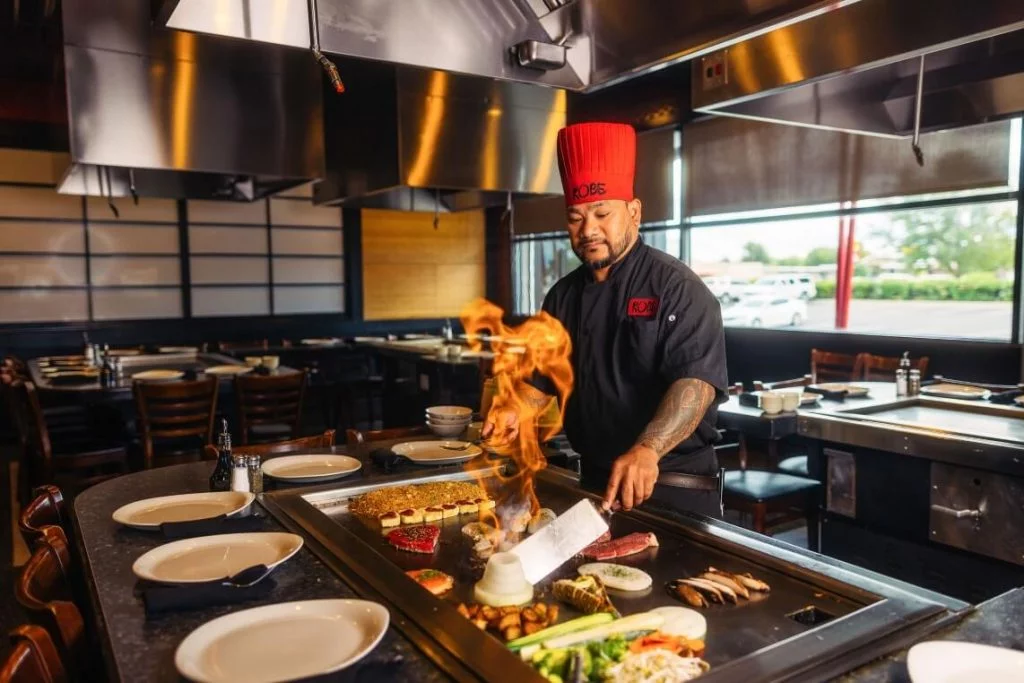
Single-server tip attribution breaks down the moment more than one person actually works the table. A hibachi party pulls a chef, a server, and often support staff together to deliver one experience, and a large party or banquet is rarely one person's job either. Forcing team-based service into single-server tip math creates disputes, manual overrides, and employees who cannot trust they were paid for what they actually did. The fix is to group the people who worked together and split the tip across the team, automatically, using rules the restaurant sets once.
This post explains why single-server tip attribution fails for team-based service, what group attribution looks like in practice, and how to configure it so the math matches how the shift actually happened. The worked example is Kobe Japanese Steakhouse, a hibachi and teppanyaki restaurant that brought full pay transparency to its floor with PayDay Portal. The same approach applies to any restaurant where large parties, banquets, or a show-style service model mean more than one person works a table.
Why single-server tip attribution fails for team-based service
Most tip systems still assume one server owns one table. That assumption holds for a two-top handled start to finish by a single person. It falls apart the moment a table becomes a production: a hibachi party where a chef runs the show, a server manages the room, and support staff refill drinks and clear plates, all contributing to the same tip. Three things break when single-server attribution meets team-based service:
- Manual math becomes the norm, not the exception. A table worked by four staff cannot run on a single-server assumption. Someone ends up doing the split by hand, every time it happens, which on a busy night is most of the room.
- Disputes happen at the worst possible time. End-of-shift disagreements about who covered what section undermine trust exactly when the team should feel good about a busy, successful night.
- The record does not match what actually happened. Without a system built for group service, there is no clean record of who actually worked a given party, which makes payroll, reporting, and trust all harder to get right.
Configure group attribution, not a workaround
The fix is not a better spreadsheet. It is a system that treats a group of employees working one party as a single unit, with a split that follows rules the restaurant has already set, rather than a judgment call made under pressure at the end of a shift.
Capture how a party is actually staffed. The starting point is letting a manager or the system itself group the specific employees who worked a given party or table, not just the one name on the ticket. That group might change table to table and night to night, and the system needs to capture it as it happens, not reconstruct it afterward.
Let the split follow rules the house has already set. Once the group is captured, the tip split should run automatically according to rules the restaurant defines in advance, whether that is an even split, a role-weighted split, or something specific to how a given service model works. Nobody should be deciding the split in the moment.
Keep the record clean for payroll and reporting. A group attribution system should leave a clear record behind: who was on a given party, how the tip was split, and why. That record protects the business during a dispute and gives employees a way to see exactly how their pay was calculated, rather than taking it on faith.
Single-server attribution vs. group attribution
| Question | Single-server attribution | Group attribution |
|---|---|---|
| Who gets credit for a large party? | Whoever is logged as the primary server, even if others helped | Every team member who worked the party, split by rules the house has set |
| What happens with a last-minute staffing pull? | A manual override, tracked separately from the normal system | The system reflects who actually worked, not just who was originally scheduled |
| How are disputes handled? | End-of-shift conversations and manager judgment calls | Rules-based splits set in advance, applied the same way every time |
| What does the record show later? | A single name tied to the ticket | A full team record tied to the party |
Why team-based service needs this the most
A restaurant where every table is worked by one server can get by with simpler tip math. A restaurant built around a show, a large party, or banquet service cannot, because the gap between how tips are actually earned and how they are attributed only grows with the size of the team on a table.
Large parties are the norm, not the exception. At a hibachi table, a banquet room, or any restaurant that regularly seats big groups, team-worked tables are not a rare event that needs a manual workaround. They are a core part of how the floor runs every night, and the tip system needs to be built for that reality from the start.
Staff move across sections and support each other constantly. Hibachi chefs, servers, and support staff routinely cross into each other's sections to keep a big night moving. A tip system anchored to a single assigned section cannot capture that kind of fluid, team-based coverage without constant manual correction.
Trust is the product. In a hospitality business built around a show, the quality of the experience depends on the team performing it feeling fairly and transparently paid. When tip math is opaque or inconsistent, that erodes the same trust the business depends on to deliver a great night on the floor.
See how Kobe Japanese Steakhouse solved this with Team Up
Kobe Japanese Steakhouse brought full pay transparency to the hibachi floor with PayDay Portal. Team Up lets managers group the chefs, servers, and support staff who worked a large party and split the tips across that team automatically, according to the rules Kobe has set.
Read the Kobe Japanese Steakhouse success story →What to ask a tip platform about team-based service
Restaurants built around team-based service should ask four questions when evaluating a tip platform. The right answers surface fast.
Can the platform group multiple employees on a single party or ticket? If the answer is a single-server field with a manual note for anyone else who helped, the platform is not built for team-based service. Group attribution needs to be a real feature, not a workaround.
Does the split follow rules the restaurant sets, or does it require manual overrides? Ask whether the split runs automatically once a group is captured, or whether a manager has to calculate it by hand every time. The whole point of group attribution is removing that manual step.
How does the platform handle last-minute staffing changes mid-shift? Staff get pulled onto a table at the last minute constantly in team-based service. The platform needs to reflect who actually worked a party, not just who was scheduled for it at the start of the shift.
Is there a clean record of who worked what, for both employees and management? A platform built for team-based service should leave behind a record that both a manager and an employee can review, showing exactly who was grouped on a party and how the tip was split. If that record does not exist, disputes have nothing to resolve them.
How Kobe Japanese Steakhouse solved team-based tip distribution
Kobe Japanese Steakhouse, voted the #1 Japanese Restaurant, runs a hospitality experience built around the table, with hibachi chefs, servers, and support staff all playing a role in the show. Large parties only amplify that dynamic, often pulling multiple chefs and servers together to deliver one cohesive experience. Kobe worked with Gratuity Solutions to deploy PayDay Portal in a configuration built around exactly that reality. The setup had four parts:
- Tips distributed through payroll. Every tip dollar earned at Kobe is calculated, allocated, and routed directly into payroll, with no cash envelopes and no separate reconciliation track.
- Team Up for large parties. Managers group the chefs, servers, and support staff who worked a large party together, and PayDay Portal splits the tips across that team automatically, according to the rules Kobe has set.
- Bilingual mobile app. Every Kobe employee accesses their pay through the PayDay Portal app, available on iOS and Google Play, in English and Spanish.
- Full pay transparency. Through the app, every employee sees their tips, hours, and pay clearly, including how a team split was calculated.
Large parties now get distributed fairly across the people who actually worked them, with no more manual math at the end of the shift and no more disagreements about who was working what table. The system handles it the way the work actually happened, and Kobe's team gets a pay experience that matches the quality of the service they put on the floor every night.
The takeaway for team-based service restaurants
A tip system built around single-server assumptions is not really built for a restaurant where service is a team effort. It is a workaround that happens to function on a slow night and breaks down on a busy one. The fix is to capture how a party is actually staffed, let the split follow rules set in advance, and keep a clean record behind every split.
The questions to ask before choosing a platform are direct. Can it group multiple employees on one party? Does the split run automatically, or does a manager still do the math? Does it reflect last-minute staffing changes? Is there a clean record for both employees and management to see? If the answers are yes, team-based service gets paid the way it actually works. If they are not, every busy night is going to cost more in manual time and disputes than it should.